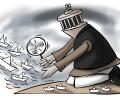
As India goes into firming up trade deals with developed nations like Australia, the United Kingdom (UK) and the regional bloc, and the European Union (EU), it will have to be well prepared to negotiate on new-generation issues, such as data protection regulation, e-commerce, and environment. India is yet to negotiate pacts with its trading partners on these evolving issues since discussions between them have until now been largely focused on tariff and non-tariff barriers and the rules of origin. "We can no longer look at trade just as trade. We have to look at it in totality of global and regional conditions.
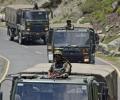
'The one aspect which no Indian military thinker would wish to see emerge is a LoC type of posture at the LAC.' 'The LoC is manned for 750 km and terrorist infiltration has led to the creation of a virtual fortress along its entire length.' 'Something mirroring this at the LAC is going to be expensive although deployment everywhere is not warranted there.' 'However, given the complete trust deficit, there appear few alternatives,' notes Lieutenant General Syed Ata Hasnain (retd).

'Ensuring through diplomatic means and in conjunction with strategic partners that India will not be required to fight a simultaneous two-front war with China and Pakistan.' Brigadier Gurmeet Kanwal (retd) lists what India must have in its national security strategy.

The USS John Paul Jones acted like a dog marking the lamp post, observes Ambassador M K Bhadrakumar.
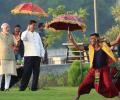
A sensational interview on India-China ties, with the man most qualified to answer.
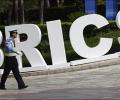
A feature of this year's BRICS summit was economic cooperation.
.jpg)
In cyber security, India's main concerns are Pakistani and Chinese espionage. Which is exactly why the US needs to build up partnership with India.

"The RSS is trying to change the nature of India. Other parties haven't tried to capture India's institutions," he said.

We must see New Delhi's position as a signal of competition to the Chinese grand design for the 21st century world, says Nitin Pai.

Finance Minister Arun Jaitley on his maiden visit as minister to Washington, DC, addresses two think thanks, leaves American Establishment impressed, reports Aziz Haniffa/Rediff.com.

'GIFT City is now on a growth trajectory,' says Tapan Ray, MD and group CEO, GIFT City, 'The time has come for the GIFT City to take the big leap and emerge as the next financial hub of Asia.'

The new missile could deliver 2,000 to 3,500 kilograms of payload to any point in the continental US, notes Rajaram Panda.

'The military aim in a future conflict, if it can't be avoided, should be to cause maximum damage to the adversary's war waging capability and capture limited amount of territory as a bargaining counter,' says Brigadier Gurmeet Kanwal (retd).

The BRICS summit offers Modi an excellent platform to reach out to world leaders and conduct diplomacy on the very ticklish issue of reform of the world governance structure, and to exchange notes with his peers on international, regional and bilateral issues on the margins of the meeting, says Rup Narayan Das.

Diplomats agree that amid stormy relations with China and Pakistan, Modi has posted impressive foreign policy successes, notes Aditi Phadnis.
Arvind Subramanian talks about US and China's power play and where India figures in these dynamics.
India's national security strategy needs to be revised periodically since the global and regional geopolitical situation is dynamic, points out Commodore Venugopal Menon (retd).

Rediff.com present a comprehensive listing of the nuclear nations and their collective and active stockpile.

All the three issues raised by China at the Modi-Xi meeting are either intractable or peripheral to the bilateral relations and suggest conventional methods to placate the other side without yielding much, says Srikanth Kondapalli.
The US wants its trade with India to grow multi-fold, Assistant Secretary of State for South and Central Asia Nisha Desai Biswal told lawmakers.

'Pakistan has worsted India in the Afghan proxy war and the defeat becomes a template of regional politics,' points out Ambassador M K Bhadrakumar.

Ahead of the G-20 summit in Osaka this week, Xi has reasserted China's role as a global player, points out Dr Rajaram Panda.

'What we are actually missing in India is a platform wherein the government engages with cybersecurity experts, gets them employed and then utilises their capability to deter such attacks.'

December 3, 2021 marks 50 years since the beginning of the 1971 War which ended in a decisive military victory for India and the liberation of Bangladesh. Most analysts of the 1971 War agree that the IV Corps dash across the mighty Meghna river led by the brilliant General Sagat Singh was the turning point in the war, recalls military historian Colonel Anil A Athale (retd).

'The question remains: Was the Obama visit truly a success? Only the future will tell us if the "breakthrough" in the nuclear liability issue will concretise into electricity.' 'As importantly, it will be interesting to watch how India's relations with China will evolve in the months to come.'

'This novel format of diplomacy -- the informal summit -- will not only facilitate bilateral communication and reduce miscalculations at the very top level of the two governments, but possibly open the space for China and India to speak in one voice on various issues of mutual concern,' note Feng Renjie and Ding Kun Lei

The govt hiked defence budget by 7.81 per cent over last year's Rs 2.74 lakh crore.

As the context of Panchsheel has changed, it is all the more essential that India and China need to reinvent and redefine Panchsheel for a new world order taking into account globalisation, and mutual economic interdependence. The new Panchsheel, in order to be relevant, needs to shed its binary approach of west verses the east recognising the seamlessness of global frontiers, which globalisation has brought in, says Rup Narayan Das.

In spite of irritants and hiccups in the relationship, a few deliverables are expected of the prime minister's visit to China, says Rup Narayan Das.

'Only when India's adversaries are convinced that India has both the necessary political and military will and the hardware to respond to a nuclear strike with punitive retaliation that will inflict unacceptable loss of human life and unprecedented material damage, will they be deterred,' says Brigadier Gurmeet Kanwal (retd).

Vietnam is a key player in India's act east policy under Prime Minister Narendra Modi. From India's perspective, a strategic partnership with Vietnam will only deepen political, economic, and security ties and be a bulwark against China, say Melissa S Hersh and Dr Ajey Lele

India has an unprecedented opportunity to develop solar industry because like China, it offers scale which is critical to reducing costs and to stimulate innovation, says Shyam Saran.

In the light of India's increasingly 'darkening' threat environment and the convergence of strategic interests between China and Pakistan, the IAF's declining combat capabilities are a cause for concern, says Brigadier Gurmeet Kanwal (retd).

'China's growing nexus with Pakistan and the two countries' unresolved territorial disputes with India continue to pose a formidable national security threat to India,' says Brigadier Gurmeet Kanwal (retd).

Hein Kiessling has the kind of access in Pakistan that journalists (and spies) would die for, says Kanika Datta.
'A conventional war is not in fashion today and not seen as being able to deliver the objective.' 'Perhaps surgical strikes that are deeper, this time not on Pakistan's terrorist facilities, but on Pakistan army facilities.' 'The nation has to be prepared for losses.' 'War is not something that can be pussyfooted around.' 'If we go for limited number of posts in Kashmir, these are very difficult posts to capture and very difficult operations.' 'Be prepared for 200 to 300 killed.'
Though growth in China is unlikely to slow down soon, India should prepare to take advantage of a shifting of gears there.

'Over the last two decades, the India-French relationship has grown steadily, no major political difference having darkened the sky between Paris and Delhi,' says Claude Arpi.
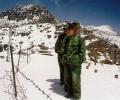
Even as Chinese troops began withdrawing from the Chumar area in Ladakh, the official media in China accused India of "instigating" incidents on the borders to divert attention during important visits of Chinese leaders.
The major driver of Mod's foreign policy can be gauged from his economic priorities such as creating employment opportunities for the youth bulge. Related to this is emphasis on manufacturing, and infrastructure development, which in turn raises the issue of FDI. He has already articulated his views on all these issues, says Rup Narayan Das.
